
ACROSS ASIA, exhibition halls are filling again. Hong Kong and Singapore are back on the global MICE circuit, with even new events in Southeast Asia, notably Jakarta and Bangkok.
To the casual observer, the recovery looks solid. Buoyed by pent‑up demand and the region’s continuing rise as an outbound meetings and incentives powerhouse, MICE-show organisers are confident.
Yet beneath the surface, a more uncomfortable question is circulating among exhibitors: do traditional B2B trade shows still justify their cost?
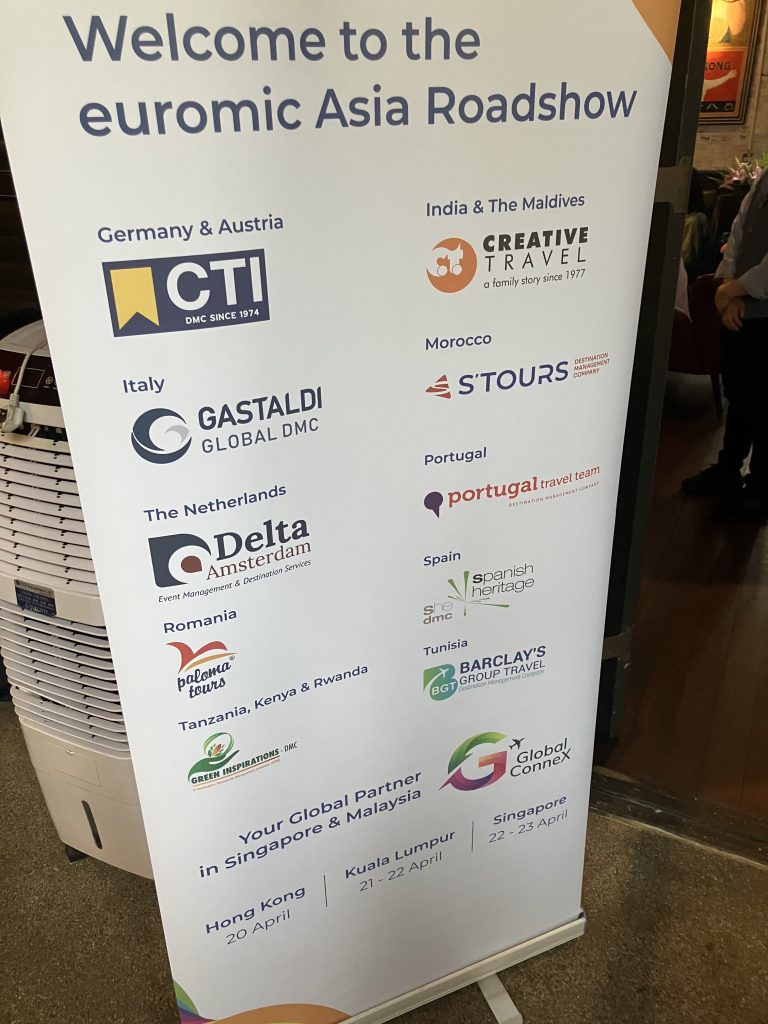
That question sits at the heart of Euromic’s Southeast Asia Roadshow, a curated programme bringing European destination management companies to Hong Kong, Kuala Lumpur and Singapore.
It’s been taking place this week, following an event in Singapore billed as “Asia Pacific’s Leading MICE Trade Show” – but pointedly without the association taking a stand on the show floor at Sands Expo. Euromic’s roadshow was not framed as a protest. It did not need to be. Its very existence was the message.
MIX went along to the roadshow’s first stop – held in a lavish restaurant in the iconic Tai Kwun heritage centre, before Hong Kong’s well-heeled arrived for Monday dining. What I heard from DMCs who were at the event would not whet the appetite for MICE trade show organisers seeking exhibitors whose pockets aren’t as deep as hotel giants or tourism boards.
For years, large trade exhibitions have been the default marketplace for Asia‑Pacific MICE business – far removed from a posh eatery during a quiet period. Euromic’s Hong Kong event saw a compact table-top meeting arrangement, while the roadshow stops in Kuala Lumpur had more buyers attending and seminars on how to work best with European tax laws and advanced negotiation skills.
The sentiment within the stylish Madame Fu in Tai Kwun, was that for too long suppliers have accepted the high costs of booth construction, travel, staffing and time away from operations believing that volume would translate into opportunity. The diary would be full; the pipeline would follow. Increasingly, that formula is becoming hard to digest.
What exhibitors question today is not attendance, but return on relevance. As previously laid out in by commentators in the travel-trade press, hosted-buyer programmes, especially in fast‑growing Asian markets, struggle to distinguish clearly between true corporate decision‑makers, intermediaries and early‑stage researchers.
Meetings multiply, but outcomes are thin, they say. For DMCs – whose work is bespoke, relationship‑driven and resource‑intensive – the opportunity cost of unfocused conversations amid a trade-show jamboree is significant.
More… Time for MICE trade shows to get wise
Euromic’s response is pragmatic rather than disruptive, but the effect could well be exactly that. The association organised its own roadshow because doing otherwise no longer made economic sense. Its members were brought directly to targeted outbound markets, into tightly controlled buyer-supplier meetings, capped in number and matched by strategy rather than scale.
There were no announcements urging a finish to a 10-minute conversation before another meeting appointment beckoned. All this in the ambience of a former prison, courthouse and police barracks repurposed as a heritage centre with event spaces and upmarket F&B outlets.
The casual meeting model was tried just before the pandemic gripped when the Get Global show ran in Sydney for two or three years. It’s unclear what the business benefits were, but the change in atmosphere was welcomed by buyers and suppliers.
Roadshows in the format organised by Euromic – and some big government-backed tourism bodies – have potential in Asia‑Pacific because suppliers feel they align with how business is done.
From the Archive… Trade shows battle to stay in the game
Trust is built through depth, not speed; credibility through conversation, not footfall. The disruptive implication is clear, however, trade-show organisers can no longer accept have a monopoly on market access.
This is not the end of the B2B MICE industry exhibition. Big events will continue to matter for branding, market entry and networking, particularly in a region as diverse as Asia‑Pacific. But they are no longer unchallenged as the primary sales platform for suppliers who must account carefully for time and capital.
What Euromic’s Asia Roadshow exposes is the emergence of what the boffins of business studies may call parallel commercial ecosystems – association‑led, supplier‑controlled and locally focused. As more exhibitors experiment with such models, exhibition organisers face an uncomfortable test.