
A WELL-EARNED round of applause to Our Hong Kong Foundation for its recent report: Riding the Wave: Transforming Hong Kong into a Green Mega-Event Capital.
In the 20 years I’ve been banging the drum for greener events across Asia, this is the first substantial policy proposal I’ve seen that treats sustainability as more than a decorative leaf on the conference logo.
Better late than never. Hong Kong traffic has taught us that “eventually” is still a form of arrival.
While I don’t see much evidence that the report was written by people who have spent many sleepless nights on a loading dock at 2am, it does appear the authors spoke with people who have.
The long-standing proposal by Kristen Bell of WhatIf Events for a government-supported, non-profit warehouse of reusable staging and event materials seems to have found its way into the conversation.
Matthew Mak, of Earth Production, may also have contributed insights into the unique sustainability headaches of the exhibition industry. If so, that’s encouraging. Good policy should always start with people who’ve actually had to lift the boxes.
One recommendation deserves particular praise:
To ensure accuracy, organisers should engage an accredited third-party auditor or sustainability consultancy to compile this post-event report.”
Absolutely! Although I’d gently suggest bringing the sustainability consultant in before the event rather than after it. Measuring success only works if you’ve decided what success looks like. More times than I care to count, a client has paused just before signing off the final design and casually remarking: “Oh, by the way… we should make this green.” That’s usually followed by my favourite event-management sound: a long, resigned sigh.
The report also recommends carbon offsetting. Here I remain unconvinced. Carbon accounting is essential. Carbon transparency? Yes, absolutely. Carbon offsets? These sometimes remind me of the medieval church’s practice of selling indulgences: carry on sinning, just remember to stop by the collection box on your way out.
More… Singapore doubles down on MICE sustainability
Offsetting has its place, but it should never become a licence to pollute with a cleaner conscience.
I also welcome the proposal for a mandatory “Green Event Plan.” My concern is that it could become yet another checklist – boxes dutifully ticked while the real decisions remain unchanged. Sustainability shouldn’t be a document; it should be a filter through which every decision passes.
That’s why I’d rather see wider adoption of ISO 20121*, the international sustainable event management standard developed from the London 2012 Olympic Games. It doesn’t simply ask whether you’ve recycled the banners. It asks whether sustainability has been built into every decision from concept to breakdown.
The report’s ambition to make these requirements mandatory by 2035 is admirable. Ambitious goals are useful. They give us something to aim at besides the catering table.
I do wonder, however, whether the authors fully appreciate that the structure of the events industry isn’t dominated by multinational corporations with endless ESG budgets. It’s a remarkably fragmented collection of small and medium-sized businesses that produce everything from global exhibitions to weddings and birthday parties. Their decisions are often driven by one stubborn reality: cost.
The so-called “green premium” isn’t usually felt by the organisers of international mega-events. It’s felt in the trenches. It’s the transport company still operating diesel coaches because replacing a fleet isn’t cheap. It’s the print shop where PVC and foam board remain significantly less expensive than recyclable cardboard and vegetable-based inks. It’s the supplier trying to do the right thing while wondering whether the client will simply choose the cheaper quote next door.
If we genuinely want the industry to change, subsidies and incentives have to reach the grassroots. Make it easier – and more affordable – for suppliers to offer greener alternatives, and the market will begin to follow.
One of the report’s strongest ideas is creating an ecosystem that supports green mega-events by aligning government venues, suppliers and organisers. It also recognises that commercial realities cannot simply be wished away.
That principle could be put into practice quite quickly. As new management contracts come into effect for the Hong Kong Convention and Exhibition Centre, perhaps build-and-strike schedules could become more flexible.
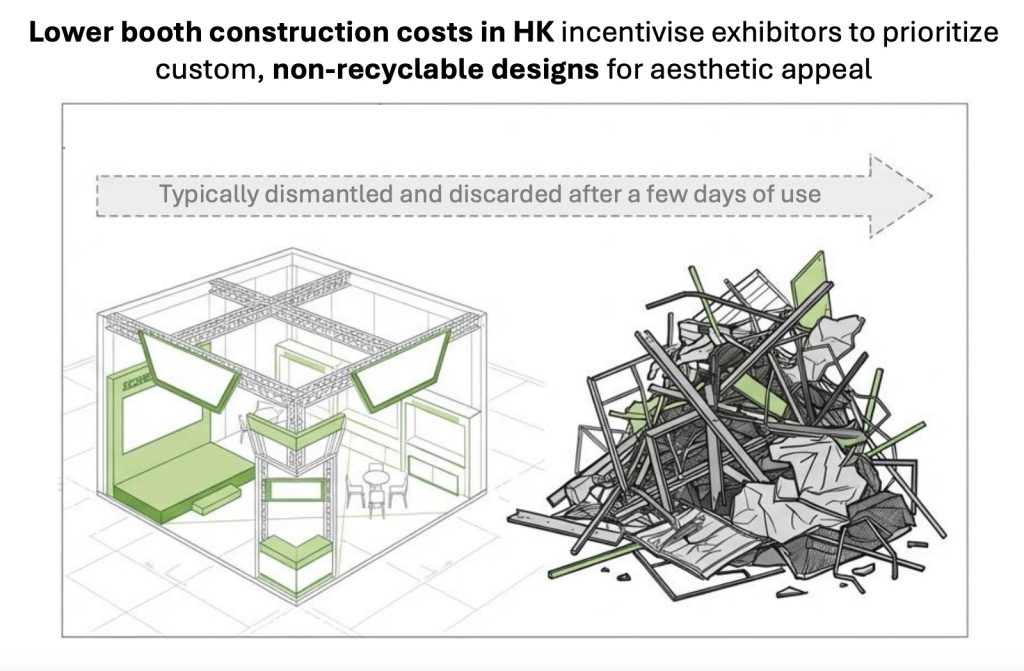
Too often perfectly reusable exhibition stands end up in landfill because paying another day’s venue rental or overnight labour simply costs less than dismantling them responsibly. Reusable modular systems certainly have their place, but exhibitors also want their shopfront to stand out. Trade shows are, after all, marketing, not uniform design competitions.
Then there’s recycling. Event producers often finish dismantling at midnight, precisely when the city’s recycling infrastructure has gone to bed. Hong Kong’s Green Centres are designed for household waste, not the peculiar mountain of timber, carpet, signage and staging materials that appears after a major exhibition closes. Perhaps a dedicated recycling service for the events industry – one that operates when events actually end – would be a practical place to begin.
What’s most encouraging about the report is its recognition that leadership must come from the top. Government support matters. Venue operators matter. Major organisers matter.
But sustainability cannot stop at mega-events.
If Hong Kong truly wants to become a green event capital, the movement has to include every conference, every exhibition, every corporate gala, every wedding and every community festival.
One practical starting point would be adopting something similar to the UK’s Green Events Code of Practice, encouraging event owners to sign a voluntary Green Pledge while simultaneously building the infrastructure and incentives that help organisers implement ISO 20121 in meaningful ways.
Real change won’t happen because someone publishes another checklist. It will happen when doing the sustainable thing becomes the easiest, most affordable thing to do.
Bring government, venues, suppliers and organisers together, build a genuinely circular event economy, and Hong Kong won’t just host greener mega-events. It will become a greener city – one capable of helping meet Hong Kong and the nation’s carbon neutrality goals by 2060.
Now that would be an event worth applauding.
*The ISO 20121 standard for sustainable event management was recently updated to the ISO 20121:2024 edition, incorporating the circular economy and planning.
Robert Rogers is a Certified Special Events Professional (CSEP) and principal at Events Man. This is a version of an article originally published on the Events Man website
Main image: The cover of the Our Hong Kong Foundation research report – Riding the Wave: Transforming Hong Kong into a Mega-Event Capital.
The report can be accessed here…